Know what every building needs, what it will cost, and what to do first.
ATOMIQ turns your property data into one costed plan for the whole estate: what to upgrade, sell, repurpose or maintain, and in what order.
- 4 sell or repurpose
- 18 major projects
- 52 targeted upgrades
- 20 value improvements
- 6 monitor
Illustrative portfolio of 100 buildings. ATOMIQ shows where to invest first, which projects to combine, and which assets should not receive more capital.



- Open London Accelerator 2025 participant
01 / The decisions owners need to make
Three questions every estate plan must answer.
Which buildings face regulatory or market risk?
Where should we invest first, and what can wait?
Which upgrades will protect income and asset value?
One issue connects them all: where to put the money.
02 / Why plan now
A better plan now can prevent rushed investment later.
Energy performance rules are changing, but they no longer follow one timetable. For non-domestic rented buildings over 1,000 square metres in England and Wales, the Government proposes EPC B from 2031 where cost-effective. Private rented homes have a separate proposed standard from October 2030. ATOMIQ keeps the rules attached to the buildings they affect.
External pressures
- Changing regulation
- Construction cost inflation
- Weaker demand for inefficient space
- Tenant energy and reporting needs
- Disruption during works
- Limited specialist capacity
- Financing and insurance terms
Decisions you control
- Capital and maintenance planning
- Portfolio procurement
- Energy and operating costs
- Lease and tenant coordination
- Grants and funding options
- 69%of industrial properties within the proposed 2031 MEES scope were below EPC B in May 2026 JLL
- Data firstPhysical surveys add time and cost across a large estate. ATOMIQ starts with available data and targets site visits where they are needed.
- TimingLate decisions can reduce procurement choice, compress delivery windows and compete with planned maintenance budgets.
Every building is different. The decisions can still follow one consistent method.
03 / How ATOMIQ works
One estate plan. One clear decision for every building.
Start with a remote baseline for every building. ATOMIQ assigns each asset to one of eleven responses, from disposal or repurposing to upgrade, protection or monitoring. It then costs and prioritises the work across the estate.
Build one baseline from the data already available.
Assign the response that best fits its condition, value, use and regulatory position.
Remove assets that need no immediate work, then rank the rest by risk, timing, cost and return.
Invest where it makes the biggest difference, in the order the estate can deliver.
04 / The eleven asset decisions
Every building has a next best action.
ATOMIQ places each building into one of eleven practical responses, from disposal and repurposing through to targeted upgrades, protection and monitoring.
Dispose or repurpose underperforming assets to protect value and reduce EPC risk.
- 01 Asset disposal
- 02 Property repurpose
Targeted upgrades for compliance and market competitiveness.
- 03 Turnaround & transform
- 04 Minimum viable upgrade
Efficient, cost-focused improvements combining asset performance, building innovation and customer culture to meet EPC standards.
- 05 Optimised for cost
- 06 Optimised for time
- 07 Optimised for value
Leverage innovation for operational and commercial performance.
- 08 Operations optimisation
- 09 Commercial performance
Protect premium assets and maintain strong market positioning.
- 10 Premium protection
- 11 Monitor and maintain
05 / Inside the platform
See the estate. Decide what happens next.
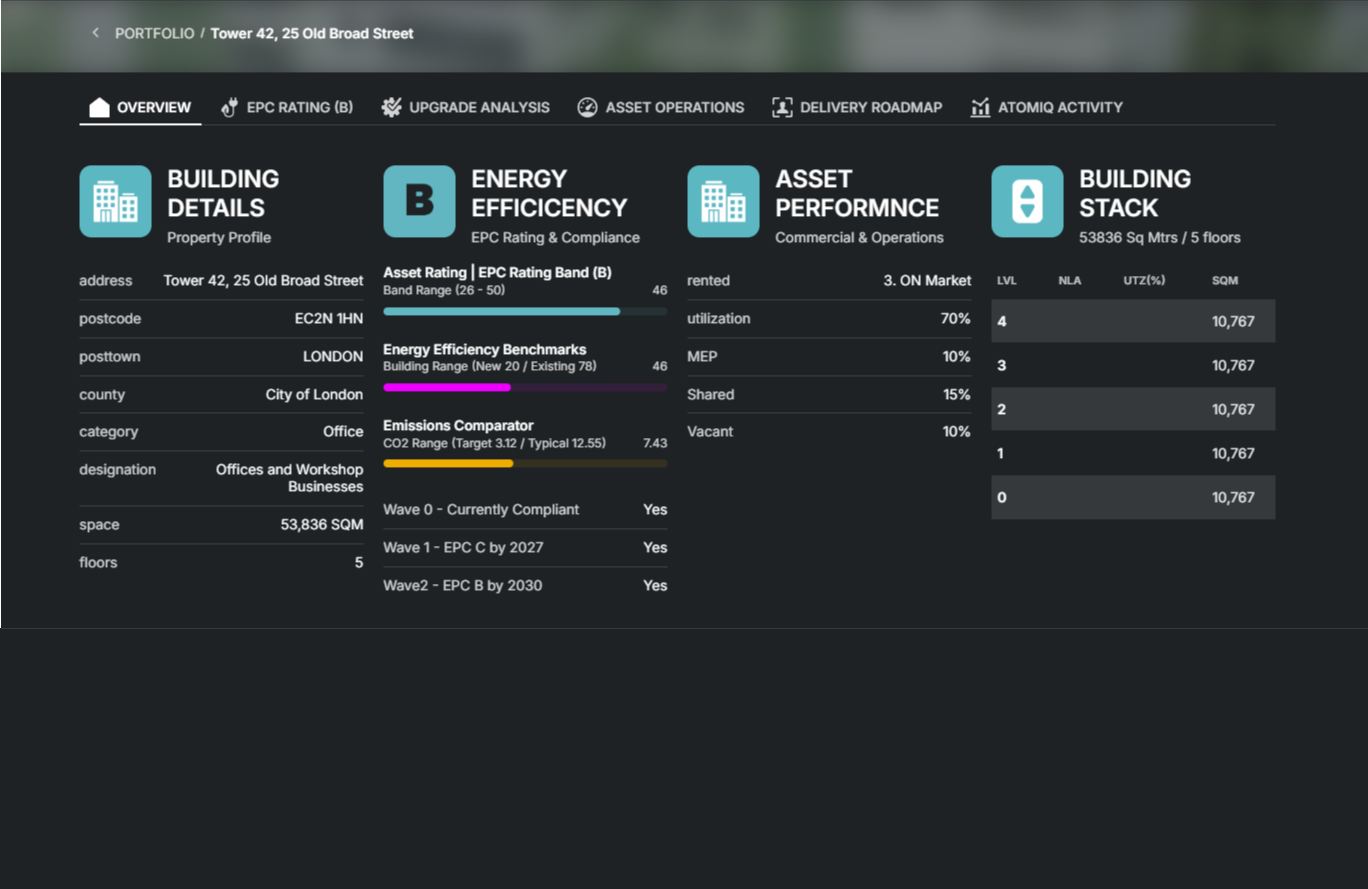

See the building, its current EPC position, energy performance, use and key risks on one screen. Where a rule applies, the platform shows whether the asset meets it.
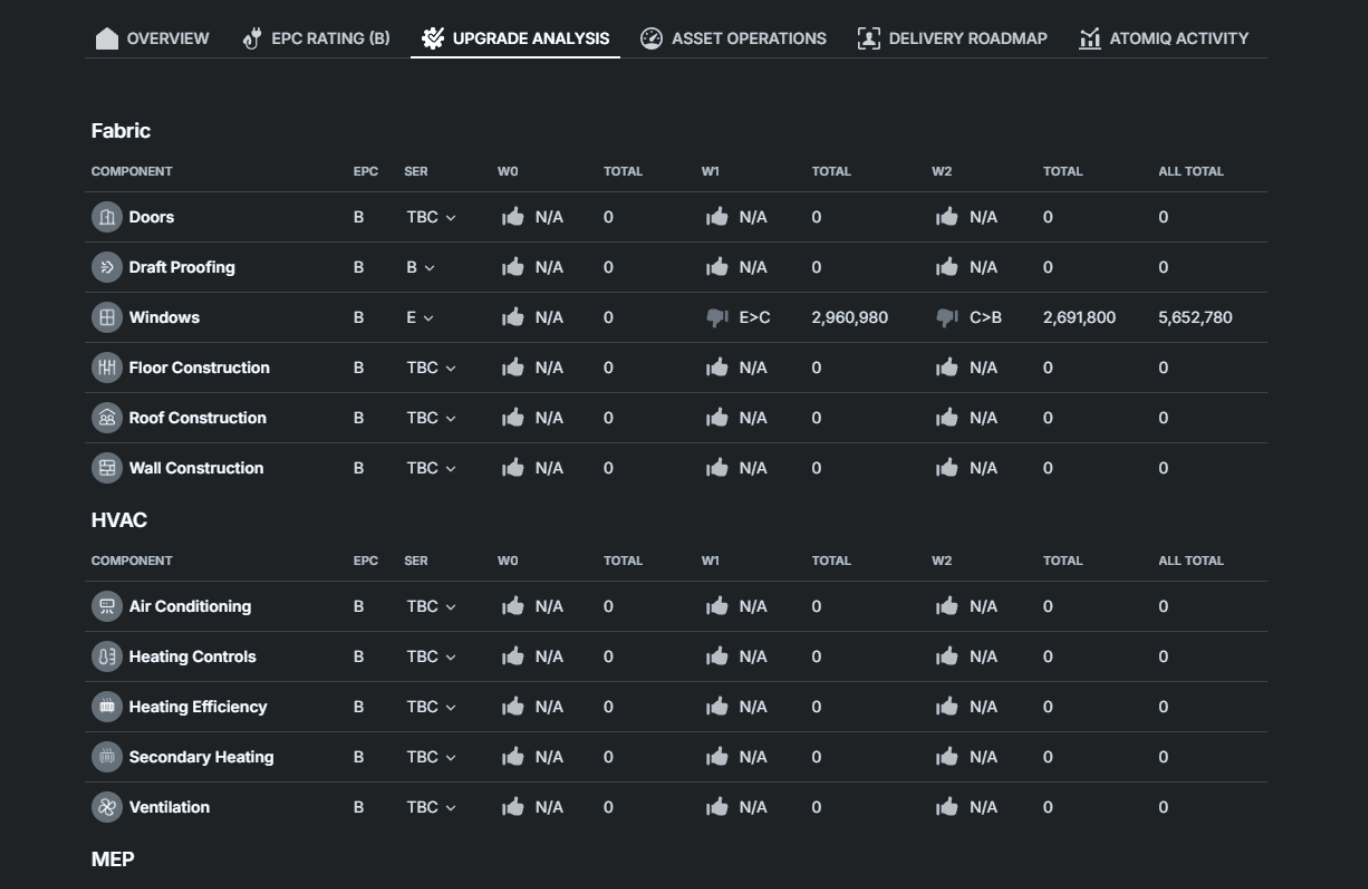
Compare upgrades to the fabric, heating and building services, with an estimated cost and the expected effect on performance.
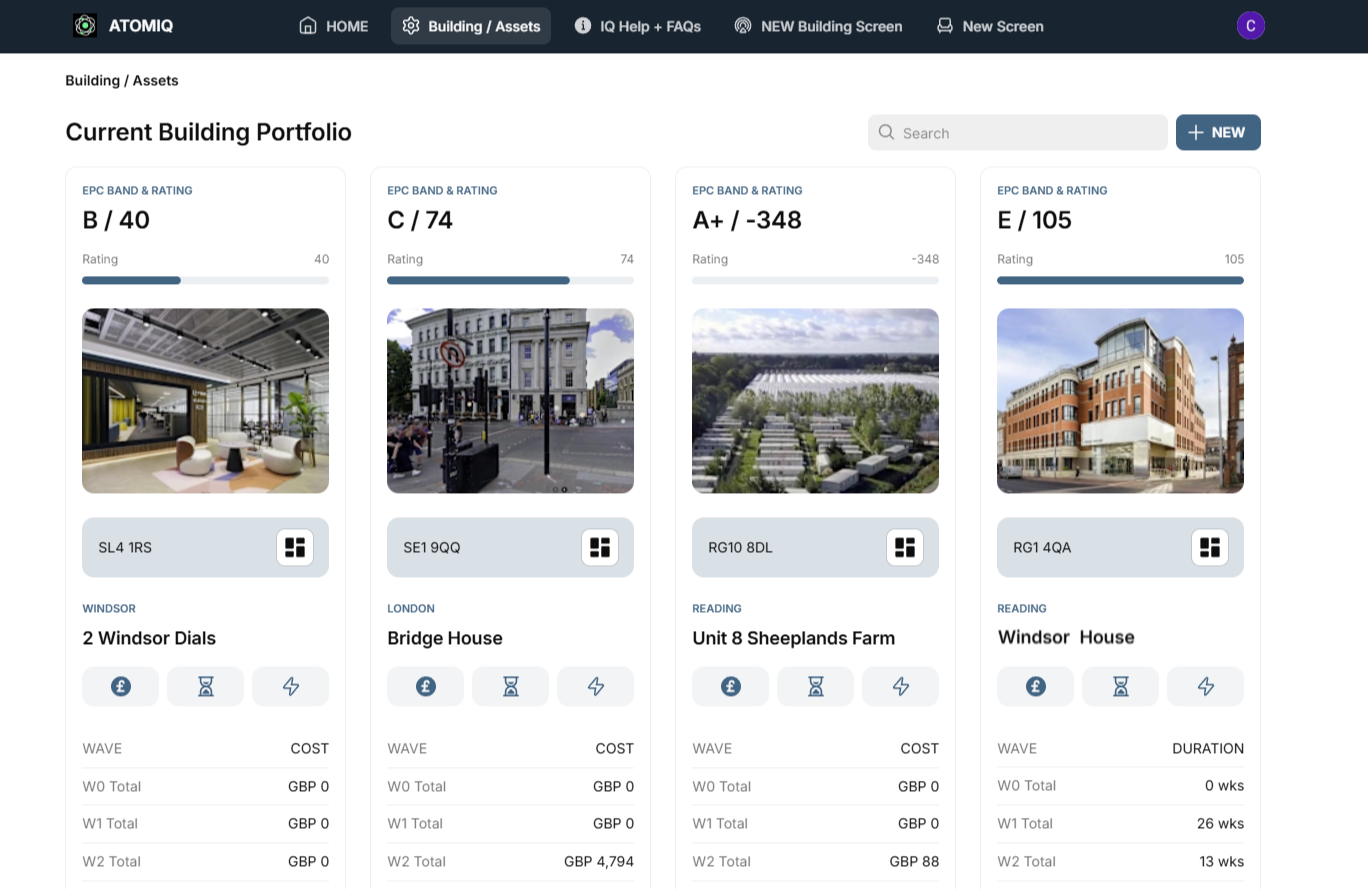
Compare EPC ratings, recommended work, estimated costs and timing across the estate without reconciling separate spreadsheets.
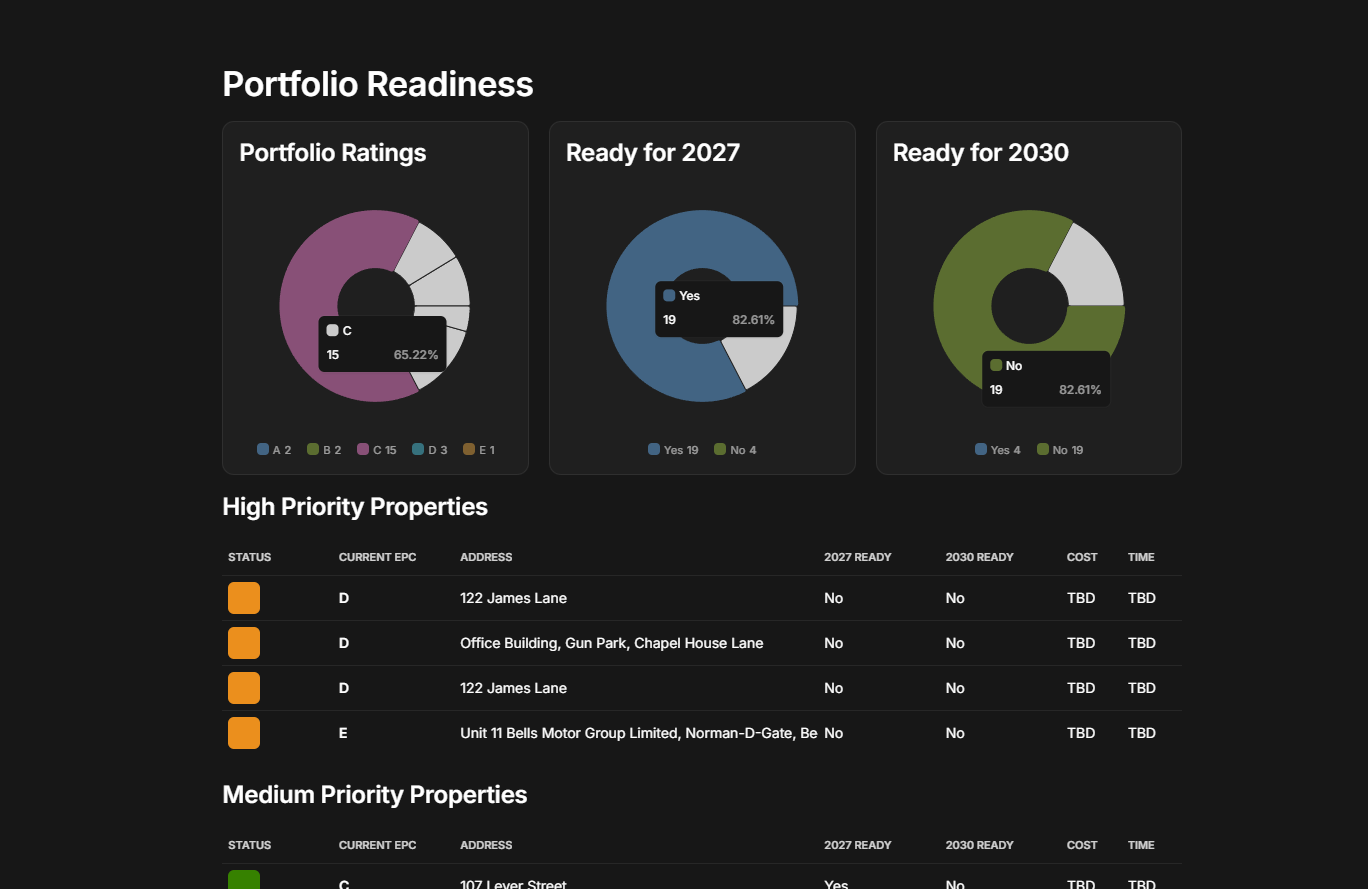
See which buildings meet the rules that apply to them, which are exposed, and where action is needed first.
06 / Where ATOMIQ can improve the business case
Where value can be found.
Capital plan
Combine work, remove low-value scope and direct investment to the assets that need it most.
Modelled potential45 to 55%CAPEX rationalisation
Operating plan
Align upgrades with maintenance, procurement, funding and energy-cost decisions.
Modelled potential15 to 25%OPEX improvement
Occupier performance
Work with tenants and users so installed systems operate as intended and savings are sustained.
Modelled potential5 to 15%Occupier-driven improvement
Illustrative ranges from the ATOMIQ benefits model, February 2026. These are modelled scenarios, not measured client results.
07 / Why ATOMIQ
Estate-wide decisions should not begin with a site visit to every building.
ATOMIQ builds the first estate baseline remotely from available property, EPC, operational and location data. Site surveys can then focus on the buildings and decisions that need them. When policy or asset data changes, the plan can be recalculated.
Protect asset value.Reduce avoidable cost.Keep the plan current as buildings, leases and regulation change.
08 / Insights for property owners
Practical guidance on EPC risk, retrofit planning and portfolio investment.

Why 2027 is closer than you think: The urgent case for EPC action in real estate
The UK commercial real estate sector is standing at the edge of a regulatory transformation. By 2027, commercial buildings must achieve a minimum Energy Performance Certificate (EPC) rating of C to be legally lettable. By 2030, that standard tightens further to EPC B. These regulations are not just administrative milestones, they mark a seismic shift in how buildings are valued, operated, and invested in.Read the article
From inertia to action: The psychology behind EPC inaction
The UK commercial real estate market is under increasing pressure to decarbonise. With Energy Performance Certificate (EPC) regulations tightening, mandating EPC C ratings by 2027 and EPC B by 2030, building owners face the dual challenge of upgrading ageing stock and aligning with net-zero targets.Read the article
Beyond the building: Why decarbonisation demands a portfolio-first strategy
In the fast-evolving landscape of sustainable real estate, decarbonisation has emerged as both a challenge and an opportunity. While many commercial landlords have begun implementing energy efficiency measures at the asset level, upgrading lighting, heating systems, or insulation, this approach often falls short of meeting the scale and complexity of net-zero real estate strategies.Read the article
09 / Memberships and support
The organisations supporting ATOMIQ.
- Part of HubIQ
- Open London Accelerator 2025 participant